
 Jun 2026
Quality Time: Dal Lake at the Hour the World Goes Quiet
If you want to understand what Kashmir offers in terms of quality time, wake up before sunrise on Dal Lake. Set your alarm for 5 a.m. You'll groan, then you'll comply, and by 5:15 you'll be standing on the wooden deck of your houseboat or gazing through the windows of your lake-view room at water that looks like hammered silver.
A lone Shikara glides past. The wukar lotus roots break the still surface in clusters. Somewhere, a muezzin calls. The mountains, dusted with morning mist, watch it all with the patience of things that have watched everything.
This is quality time, Kashmir-style. Unhurried. Uninterrupted.
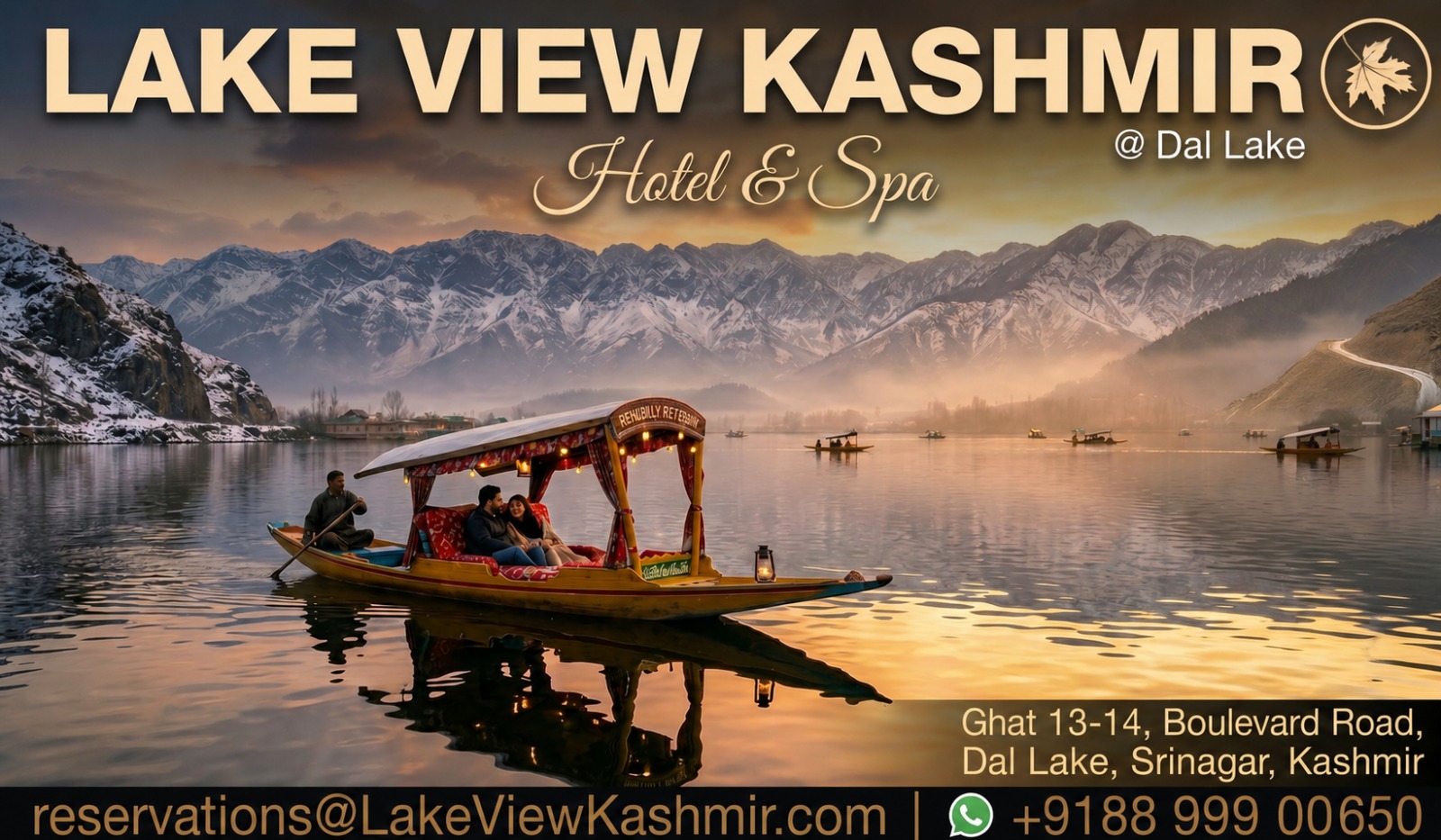
A Shikara ride on Dal Lake for a romantic Kashmir trip isn't a tourist activity; it's a ritual. Your boatman, typically a third-generation Shikara wallah who knows every inch of the lake, paddles with the ease of someone born knowing how. He doesn't rush. You drift past floating vegetable gardens, past houseboats with painted names, past children doing their homework on wooden planks suspended over the water. Time doesn't so much slow here as it simply stops performing.
Evenings are even more extraordinary. As the sun sinks behind the Zabarwan range, it sets the lake on fire copper bleeding into rose bleeding into violet. Couples sit in Shikaras, shoulders touching, not saying much. There's nothing to say when the world is doing all the talking.
Staying at Hotel Lake View Kashmir places you at the heart of this experience. The lake isn't a backdrop here it's your companion, visible from your room, woven into every morning and every evening. That proximity changes you. You stop being someone on a trip. You become someone in a place.
Acts of Service: The Kashmiri Hospitality That Leaves No Room for Loneliness
Kashmir's second love language is service, not the transactional kind, but the kind that feels almost embarrassingly generous.
You'll notice it first in the chai. It arrives without being asked, piping hot, laced with cardamom and saffron, in a samovar that has probably been in the family for four generations. Then the noon chai, the salted pink tea that sounds wrong and tastes completely right. Then the kehwa, fragrant with cinnamon and almonds, was offered like a small ceremony.
The people of Kashmir have lived through extraordinary difficulty, and yet the hospitality here is not diminished by hardship; it seems deepened by it. A local carpet weaver in the old city will spend forty minutes showing you how each knot is tied before he ever mentions a price. The family running the walnut orchard in Dachigam will wave you in for lunch without a second thought. This is a culture where generosity isn't performance; it's identity.
When you stay at Hotel Lake View Kashmir, that spirit extends into every detail: the warm welcome at reception, the staff who remember your tea preference from day one, the quiet knock on the door with an extra shawl on a cold evening. These aren't amenities. They're acts of care.
Kashmir understands, perhaps better than most places on earth, that the best way to make someone feel loved is simply to attend to them completely, unhurriedly, with pride.
Receiving Gifts: What Kashmir Puts in Your Hands and Your Heart
Kashmir's third love language is the giving of gifts, and it does so with an extravagance that is almost overwhelming.
Begin with saffron. The finest in the world, grown in the Pampore fields just outside Srinagar, where every October the land turns purple with crocus blooms and the air carries the faint, honeyed thread of the world's most expensive spice. A small vial of Kashmiri saffron, if you can get it from a trusted source, is not just a souvenir. It is land and light compressed into something you can carry home in your pocket.
Then there are the pashmina shawls, the real ones, not the machine-made imitations that flood tourist markets everywhere. A genuine Pashmina, hand-spun from the undercoat of the Changthangi goat, takes months to weave and a lifetime to understand. When it drapes across your shoulders, you feel something older than fashion. You feel warmth as craft, as inheritance, as love passed down through hands.
Then come the walnut wood carvings, intricate floral designs produced by a craft tradition unchanged for centuries. The papier-mâché boxes are painted with garden scenes in a style that dates to the 16th-century Mughal era. The dried mulberries and apricots and walnuts that fill the old bazaars around Lal Chowk. Each of these is Kashmir saying, "Take something of me with you."
What to bring home from Kashmir:
- Pampore Saffron: World's finest; buy from verified sellers or government emporiums only
- Genuine Pashmina: Hand-woven from Changthangi goat; feel the weight it should be feather-light
- Walnut Wood Carvings: Intricate floral designs; a craft tradition unchanged for centuries
- Papier-Mâché Art: Garden scenes painted in a style dating to the 16th century Mughal era
- Kashmiri Dry Fruits: Mulberries, apricots, walnuts the bazaars of Lal Chowk overflow with them
- Kani Shawls: Handloom woven with twill tapestry technique; each piece takes weeks to produce
For couples on a Kashmir honeymoon, this gifting culture adds a layer of beauty to every day. There's something quietly romantic about choosing gifts together, debating the shade of an embroidered shawl, watching a craftsman engrave a walnut box with your initials, and bringing home something made by human hands in one of the most beautiful places on earth.
Words of Affirmation: What the Mountains Say Without Speaking
Kashmir's fourth love language is harder to name because it comes in silences and sounds that somehow say more than words.
There is the sound of the Jhelum River as it runs through the old city not a roar, but a constant, low reassurance. There is the call of the hoopoe in the chinar groves of Nishat Bagh and the high, clear notes of the bulbul at dawn. There are the bells of the sheep coming down from the high passes in autumn and the sound your Shikara makes as it cuts through still water, a clean, soft division of the world into before and after.
But the loudest affirmation Kashmir offers is the silence of its mountains.
Stand in the meadow at Betaab Valley, with the Pahalgam peaks on three sides and a river running silver through the grass, and try to feel inadequate. You can't. Those mountains are not indifferent to you; they are speaking to something in you that doesn't have a name, reminding you that you are small and alive and here, and that this is extraordinary.
For couples and honeymooners, these moments become the ones you'll talk about for years. Not the meals or the photographs, but the moments when you stood somewhere beautiful together and felt the mountains say something you both understood simultaneously, without needing to translate.
A Dal Lake experience at dawn carries this same quiet power. The water speaks. The light speaks. The heron standing one-legged in the shallows speaks. Kashmir is perpetually affirming the value of being present and in the most eloquent possible language.
Physical Touch: The Feel of Kashmir on Your Skin
Kashmir's fifth love language is perhaps the most visceral and the one travel writers most often undersell.
It's the cold.
Not the punishing cold of somewhere uninhabitable, but the clean, mineral cold of mountain air, the kind that makes you feel scrubbed from the inside. Step outside on a summer morning in Kashmir, and the air hits your face like cold water from a mountain stream. It's shocking at first, then invigorating, then deeply pleasurable in a way that urban life sealed in air-conditioned offices and heated cars never quite offers. Your lungs have not breathed this kind of air in a very long time, if ever.
In winter, the snowfall transforms the valley into something that feels invented. Snow falls silently and continuously, softening every edge, muffling the world into a white hush. The first morning you wake up at a hotel near Dal Lake and open your curtains to find the whole world white and still, the houseboats frosted, and the mountains heavy with snow, the lake barely visible through the falling flakes, is the kind of morning you come back to in your memory for years.
Even in summer, Kashmir offers this physical grace. The cool of the forest floor in Pahalgam. The spray from a Betaab Valley waterfall catches the light as it hits your face. The weight of a Pashmina around your shoulders as the evening cools. The warmth of kehwa cupped between cold hands.
A Kashmir summer vacation is not just beautiful to look at; it is beautiful to be in, with your whole body, all five senses working at once.
If Kashmir Had a Love Language, Here Is the Answer
It would speak all five. Simultaneously, fluently, without effort.
It would give you time that feels stolen from ordinary life, on a lake that teaches you stillness. It would serve you kahwa and wazwan and warmth without ever asking for gratitude. It would fill your hands with saffron and pashmina and papier-mâché and say, "Take a piece of me wherever you go." It would speak to you in the language of rivers and birdsong and mountain silence, affirming everything about being alive and present. And it would press its cold air against your face every morning, reminding you — physically, undeniably — that you are somewhere completely real.
That is what Kashmir is. Not just a destination. A declaration.
Hotel Lake View Kashmir understands that a Kashmir honeymoon, or any stay in Kashmir, is not just about comfortable beds and good meals, though it offers both generously. It's about giving guests access to all five of Kashmir's love languages at once: the view that changes by the hour, the hospitality that feels personal, the proximity to markets and culture, the silence of the lake at night, and the mountain air drifting through a window left slightly open.
The best hotel near Dal Lake doesn't compete with the landscape. It opens a door to it.
Plan Your Stay in Kashmir
Best time to visit:
- Winter (Dec–Feb): Snow, Gulmarg skiing, frozen Dal Lake
- Spring (Mar–Apr): Cherry and almond blossoms across the valley (Ideal)
- Summer (May–Jul): Cool weather, full Dal bloom, Shikara season (Most Popular)
- Autumn (Sep–Nov): Chinar gold, saffron harvest in Pampore
Kashmir is most accessible from April through October, with the summer months (May–July) offering cool temperatures, full bloom gardens, and ideal Shikara weather. The spring months bring almond and cherry blossoms to the valley; autumn arrives in a slow fire of chinar leaves turning gold and red.
Srinagar is the gateway. Flights connect daily from Delhi, Mumbai, Bangalore, and other major Indian cities. From the airport, Dal Lake is roughly 30 minutes, and Hotel Lake View Kashmir sits close enough to the water that the lake becomes part of your daily rhythm from the moment you arrive.
Whether you come for a romantic Kashmir trip, a honeymoon, a family summer escape, or simply to understand why poets have been writing about this place for a thousand years, come ready to be spoken to. Kashmir has a great deal to say.
Frequently Asked Questions
Q.1 Is Kashmir a good honeymoon destination?
Absolutely. Kashmir consistently ranks among India's most romantic honeymoon destinations, offering a rare combination of natural beauty, cultural richness, and intimate experiences, such as Shikara rides on Dal Lake, Mughal garden walks, and mountain meadow picnics in Pahalgam. The spring and summer months (March–July) are particularly magical for couples. Most honeymooners find 5–7 days ideal.
Q.2 What is the best time to visit Dal Lake in Kashmir?
Dal Lake is beautiful year-round, but April through June offers the most serene experience: the water is calm, surrounding Mughal gardens are in full bloom, and the weather is pleasantly cool (15–25°C). October also offers spectacular autumn colors reflected in the lake and the saffron harvest season in nearby Pampore.
Q.3 What should I buy as souvenirs from Kashmir?
Kashmir's most prized gifts include genuine Pashmina shawls (hand-woven, not machine-made), saffron from Pampore, walnut wood handicrafts, papier-mâché art, Kani shawls, and Kashmiri dry fruits. For quality assurance, buy from reputable sellers or certified government emporiums in Srinagar's Lal Chowk or the Kashmir Government Arts Emporium.
Q.4 What makes Hotel Lake View Kashmir special for couples?
Hotel Lake View Kashmir offers guests a front-row experience of Dal Lake with lake-view rooms, proximity to Shikara ghats, warm Kashmiri hospitality, and direct access to the city's best cultural and scenic experiences. For couples, it provides the intimate, scenic setting that makes a Kashmir trip genuinely unforgettable without competing with the landscape.
Q.5 How many days are ideal for a Kashmir summer vacation?
Most travelers find 5–7 days ideal enough time for lazy mornings on Dal Lake, day trips to Pahalgam or Gulmarg, exploring the old city markets, and simply sitting still long enough to let the valley do what it does best: make you fall completely in love with it.
Q.6 How do I get to Hotel Lake View Kashmir from Srinagar Airport?
Srinagar Airport (SXR) is approximately 30 minutes from Dal Lake by road. Daily flights connect from Delhi, Mumbai, Bangalore, Kolkata, and other major Indian cities. The hotel's front desk can arrange airport transfers. Once at the hotel, Dal Lake and Shikara Ghat are within walking distance.


2 Comments
Martin King
May 15, 2025Lorem ipsum dolor sit amet, consectetur adipiscing elit. Sed do eiusmod tempor incididunt ut labore et dolore magna aliqua. Ut enim ad minim veniam, quis nostrud exercitation ullamco laboris nisi ut aliquip ex ea commodo consequat.
Martin King
May 15, 2025Lorem ipsum dolor sit amet, consectetur adipiscing elit. Sed do eiusmod tempor incididunt ut labore et dolore magna aliqua. Ut enim ad minim veniam, quis nostrud exercitation ullamco laboris nisi ut aliquip ex ea commodo consequat.